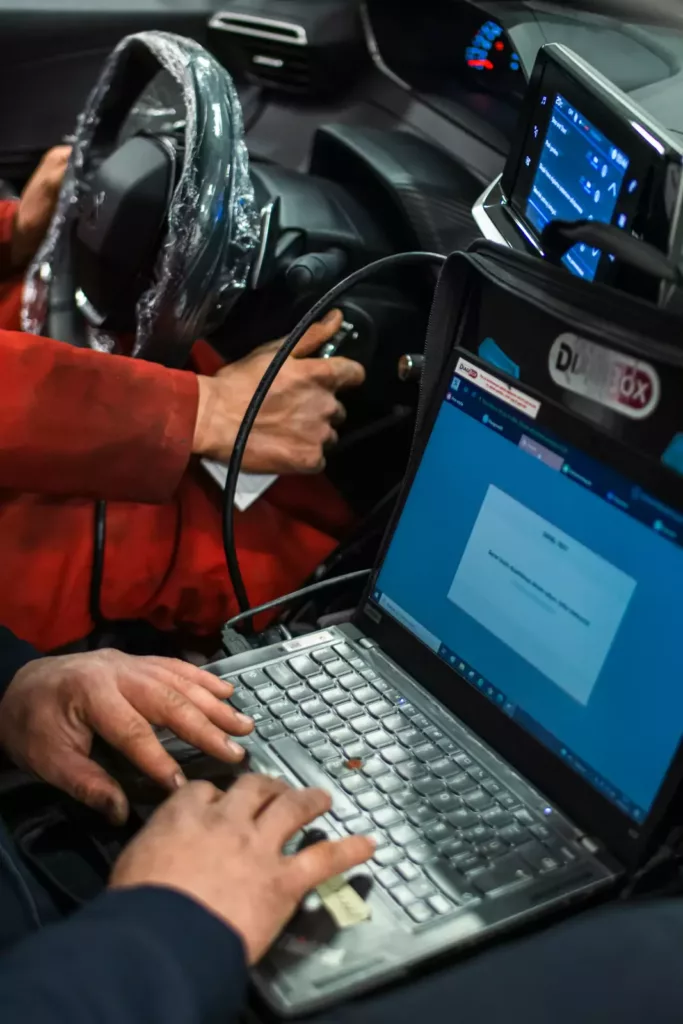
A check engine light or a mystery fault doesn’t mean you need a $40 code read at a parts store. Those tools tell you the code; they don’t tell you what’s wrong. A real diagnostic combines scan data, live sensor readings, a road test where needed, and the experience to know what the data is actually saying.
Modern vehicles run 15+ control modules — engine, transmission, ABS, airbag, body, climate, infotainment. A proper diagnostic pulls codes from all of them, not just the engine. That’s how the secondary fault that’s actually causing the primary one shows up.
Codes from every module, not just the obvious ones. A transmission code that nobody noticed often explains a “random” misfire.
Fuel trims, O2 sensors, MAF, knock activity, transmission learn values. Codes can lie. Live data tells the truth about what the engine is doing in the moment.
Some faults only show under load or at operating temperature. If the fault won’t replicate in the bay, a road test is the only way to catch it.
“When does it happen?” is half the diagnosis. Cold start? Highway speed? Only when the A/C is on? Bring the details — they shorten the search.
Codes don’t capture chafed wiring, vacuum leaks, oil contamination on connectors, or rodent damage. Those need a set of eyes on them before the parts list gets written.
Climate, road salt, and a lot of older fleet vehicles mean the same codes come through the door every week.
Often misdiagnosed as a failing catalytic converter. The real culprit is frequently an upstream O2 sensor or a stuck fuel trim. Replacing the cat without checking either is how people spend $1,200 and watch the light come back.
Coil, plug, injector, or compression on the cylinder that’s misfiring. The trick is finding which one before any parts come off. See engine repair when the diagnosis points to internal work.
Usually a gas cap or a small line leak — a smoke test pinpoints where it’s escaping.
Frequently a vacuum leak upstream rather than the sensor itself.
Fluid level, solenoid pack, or the trans learning the wrong shift points after a battery disconnect. Often fixable without a teardown.
Wheel-speed sensors get road-salt corrosion. Common on every Calgary winter beater that comes in for spring service.
A surprising share of customers who walk in with a check engine light have already had a shop “fix” the same code two or three times. New O2 sensor, then a new MAF, then a new coil — light still on, $800 down the drain, original fault still there. Common stories: O2 sensors, catalytic converters, MAF sensors, and entire coil packs replaced when the real culprit was a single chafed wire or a small vacuum leak. A real diagnostic costs less than two wrong parts.
If your check engine light is on, or your car is doing something it didn’t do last month, don’t keep driving past it. Come by Rite-Price Auto Service Centre in SE Calgary and we’ll pull the data, walk you through what it means, and only fix what’s actually broken. Call (403) 243-4204 — we’ll talk through your symptoms in 60 seconds and let you know what to expect.
If your fault is electrical (no-crank, parasitic drain, random warning lights), see car electrical repair. If you’re buying a used car and want a full system check before you sign, that’s a pre-purchase vehicle inspection.
Looking for more than just diagnostic work? Rite-Price Auto Service Centre handles a wide range of services — from engine repair and electrical work to brake service, general maintenance, and more.

Rite-Price has been on Manilla Road SE for years, and our diagnostic work is the same as the rest of the shop — straight answers, clear quotes, no parts cannon. We serve drivers from Chinook, Ogden, Lynnwood, Riverbend, Douglasdale, Acadia, Maple Ridge, Willow Park, and the rest of SE Calgary. If your check engine light is on and a previous shop didn’t get to the bottom of it, bring it in.
A diagnostic isn't just plugging in a code reader. The code points to a symptom; the cause is found through scan data, live sensor readings, a road test when the fault won't show in the bay, and a careful look for chafe, corrosion, or other damage that no scan tool can detect.
You can — and that tells you the code, not the cause. A free code read points at a sensor that's reporting a fault; it doesn't tell you whether the sensor is bad or the system the sensor is watching is bad. Most parts-cannon repair stories start with a free code read.
It depends on the fault. A straightforward code can be sorted quickly; an intermittent fault — the kind that only shows up at -20 °C or after an hour of highway driving — can take longer to pin down. Call us with the symptoms and we'll let you know what to expect.
Yes — happy to share what we found.
It happens with rare intermittent faults that won't replicate on demand. We'll tell you what we ruled out and what to try next. Call us before you start swapping parts.